Persatuan Ulama Malaysia (PUM) lancar Kelab Penyokong Dinar

Satu lagi perkembangan terbaru yang akan menyembarakkan lagi usaha memertabatkan dinar & dirham. Dua artikel ini boleh dibaca di Harian Metro dan Harakahdaily. Disertakan juga artikel ini dibawah untuk memudahkan anda.

Apa lagi, dapatkan dinar & dirham anda dari EmasDagang. Click pada Tab Jual/Beli untuk maklumat lanjut :)


 PUM lancar Kelab Penyokong Dinar

Posted on the December 23rd, 2010 under Politik by admin
 
KUALA LUMPUR, 22 Dis: Persatuan Ulama Malaysia (PUM) dengan rasminya pada hari ini melancarkan Kelab Penyokong Dinar.

Pelancaran itu dilakukan oleh Datuk Al-Sheikh Abdul Halim Abdul Kadir, Yang Dipertua PUM sempena Seminar Seminar Minisiri Dinar Emas di Putra World Trade Centre (PWTC).

Menurut Abdul Halim, penubuhan Kelab Penyokong Dinar ini merupakan sebahagian daripada usaha PUM memberi kesedaran kepada orang ramai tentang dinar emas.

“Untuk merealisasikan usaha memberi kesedaran dan kefahaman menyeluruh kepada masyarakat awam, mengenai peri pentingnya mengembalikan kebangkitan dinar emas dalam muamalah ummah, dan menggerakkan kesedaran tersebut secara dinamik dan berkesan, maka Kelab Penyokong Dinar ini dilancarkan,” ujarnya semasa menyapaikan ucaptama pada seminar itu.

Seminar sehari ini menampilkan beberapa pembentang iaitu Dr Zahimi Chik (Al-Qafilah International), Khalid Noorshah (Gold Dinar Research Group, Universiti Sains Malaysia),Khairudden Hussin (Muamalah Council), Mazli Alias (Penganalisis Pasaran Ekuiti), Redhuan Oon (Pengasas Adempiere), Abdullah Zaidi Hassan (Penyelidik Perpustakaan Islam Nur Az-Zahrah), Haji Ann Wang Seng (Setiausaha MACMA), Rafidi Hashim (Pendakwah) dan Dr Luqman Abdullah (Pensyarah Kanan Jabatan Fiqh dan Usul, Universiti Malaya).


KUALA LUMPUR: Bermuamalah menggunakan mata wang syariah bernilai hakiki iaitu dinar emas dan dirham perak jelas termaktub di dalam syariat Islam, malah perkataan dinar serta dirham disebut dalam beberapa surah al-Quran.

Sehubungan itu, Persatuan Ulama Malaysia (PUM) menyokong penggunaan dinar dan dirham sebagai langkah alternatif menggantikan mata wang konvensional yang ketika ini semakin menyusut.

Yang Dipertuanya, Datuk As-Syeikh Abdul Halim Abdul Kadir berkata, ada suatu perkara yang dulunya biasa dan amat akrab dalam kehidupan umat Islam tetapi ia kini terpinggir dan ada pihak berpendapat akibat terpinggirnya amalan itu, rata-rata umat Islam berada dalam hambatan kemiskinan sama ada dari segi iktisad (ekonomi) dan siasah (politik).

“Amalan yang terpinggir itu adalah penggunaan mata wang syariah bernilai hakiki iaitu dinar emas dan dirham perak. Penggunaan mata wang syariah itu lebih dekat dengan Islam dan mempunyai pelbagai kelebihan seperti mengelakkan riba yang kebiasaannya diguna pakai secara berleluasa dalam aktiviti perbankan dan wang kertas.

“Emas adalah wang paling stabil pernah digunakan manusia dan ia sudah terbukti digunakan sejak daripada awal tamadun Islam sehingga ke hari ini. Kestabilan nilai emas dapat mengelakkan daripada berlakunya inflasi dan krisis ekonomi.

“Malah, emas tidak boleh dicetak sewenang-wenangnya oleh sesebuah kerajaan seperti wang kertas menyebabkan nilainya tidak mungkin susut atau jatuh seperti mana nilai wang yang digunakan sekarang,” katanya ketika ditemui selepas Seminar Minisiri Dinar Emas bertajuk ‘Kebangkitan Dinar Emas Dalam Muamalah Ummah’ di Pusat Dagangan Dunia Putra (PWTC) di sini, semalam.


Seminar sehari dengan kerjasama Al-Qafilah International Sdn Bhd itu dihadiri kira-kira 60 peserta termasuk ahli perniagaan dan pelajar universiti yang membincangkan penggunaan mata wang syariah dari sudut agama dan ekonomi.

Abdul Halim berkata, kesohoran dinar sebagai mata wang rasmi dalam sektor ekonomi sudah lama disemat dalam sejarah tamadun Islam dan pernah digunakan di Madinah ketika zaman Nabi Muhammad s.a.w dan diperluaskan pada zaman Khulafa al-Rashidin ke seluruh dunia, tetapi Bapa Turki Moden, Mustaffa Kamal Atartuk membatalkan penggunaan dinar sebagai mata wang dan menggantikannya dengan syiling dari Barat pada 1924.

Beliau berkata, di Tanah Melayu pula, Kelantan pernah membayar ufti kepada Siam dalam bentuk bunga diukir daripada emas manakala Kerajaan Melayu Melaka pernah membayar ufti kepada Siam dan China dalam bentuk sama.

“Urusan dinar adalah urusan agama dan kedaulatan daulah Islamiah dan penggunaan dinar melambangkan ketundukan dan kepatuhan kita kepada perintah Allah menyebabkan kebangkitan muamalah ini amat mustahak dalam membentuk ummah bersatu dan disegani.

“Satu dinar melambangkan penyatuan satu ummah dan sudah pasti melangkaui sempadan, bahasa dan warna kulit,” katanya.


Perbandingan Antara Pelaburan Emas dan Perak

Melihat kepada kenaikan harga komoditi ini, saya hanya ingin mengulas mengenai perbandingan antara peningkatan nilai untuk emas dan perak. Walau bagaimana pun, sesuatu yang patut kita perhatikan adalah, semua barang komoditi naik, inilah kesan daripada sistem ekonomi yang kita ada sekarang (wang kertas / fiat money), selagi mana kita tidak berbalik kepada sistem yang berasaskan kepada emas & perak, harga barangan akan terus naik. Perlu diingat, kenaikan harga komoditi mempunyai kesan yang amat rapat dengan kehidupan seharian kita.

Berbalik kepada emas dan perak, peningkatan nilai untuk emas (bandingan antara Januari 2009 sehingga sekarang) adalah 47%. Perak pula pada masa yang sama, naik sebanyak 93%. Hal ini sangat konsisten dengan hasil kajian & penulisan pakar-pakar yang mengatakan bahawa, harga perak sekarang adalah dibawah nilainya yang sebenar. Sekiranya anda ingin membaca lebih lanjut sila click link ini.

Melihat kepada situasi ini, apa tindakan anda sekarang ? Melihat sahaja atau mula untuk melabur di dalam logam perak ? Pilihan berada ditangan anda :)

Selepas Abu Dhabi, di Florida pula, Di Malaysia? Gold Vending Machine

Fancy ATM skips the folding cash, spits out gold

FILE - In this photo made available by Ex Oriente Lux company, Thomas Geissler the CEO of Ex Oriente Lux, left, and an Emirati official remove the cov AP – FILE - In this photo made available by Ex Oriente Lux company, Thomas Geissler the CEO of Ex Oriente … 
 
BOCA RATON, Fla. – Shoppers who are looking for something sparkly to put under the Christmas tree can skip the jewelry and go straight to the source: an ATM that dispenses shiny 24-carat gold bars and coins.

A German company installed the machine Friday at an upscale mall in Boca Raton, a South Florida paradise of palm trees, pink buildings and wealthy retirees.


Thomas Geissler, CEO of Ex Oriente Lux and inventor of the Gold To Go machines, says the majority of buyers will be walk-ups enamored by the novelty. But he says they're also convenient for more serious investors looking to bypass the hassle of buying gold at pawn shops and over the Internet.

"Instead of buying flowers or chocolates, which is gone after two or three minutes, this will stay for the next few hundreds years," Geissler told The Associated Press in a telephone interview.

The company installed its first machine at Abu Dhabi's Emirates Palace hotel in May and followed up with gold ATMs in Germany, Spain and Italy. Geissler said they plan to unroll a few hundred machines worldwide in 2011. He said the Abu Dhabi machine has been so popular it has to be restocked every two days.
A bank in Vietnam installed its own brand of the machines in a country with a much poorer population but one that values gold more than paper money.

The gold-leaf-covered machine at Boca Raton's Town Center Mall sits outside a gourmet chocolate store and works much like the cash ATM beside it. Shoppers insert cash or credit cards and use a computer touch-screen to choose the weight and style they want. The machine spits out the gold in a classy black box with a tamperproof seal.

Each machine, manufactured in Germany, carries about 320 pieces of different-sized bars and coins. Prices are refigured automatically every 10 minutes to reflect market fluctuations. On Friday, a two-gram piece cost about $122, including packaging, certification and a 5 percent markup. An ounce cost about $1,442.
Buyer beware: A gram of the heavy metal is much smaller than you think, about the size of a fingernail. An ounce is a little larger than a quarter.

Florence Schneider, who checked out the machine Friday, said she might use it, but only if she needed a unique gift.

"I can't see it being successful. Maybe for Christmas as a gimmick," said the 78-year-old Boca Raton resident. "If I knew someone was having a big birthday coming up I'd buy it for something different."
Owners said the machine, which will hold around $150,000 in cash and gold, will be flanked by an armed bodyguard for now. Several live security cameras are fixed inside and outside the machine.
The popularity of gold is cyclical, but it's riding high these days in part because of fears stoked by financial troubles.

Geissler, who plans to open a machine in Las Vegas by the year's end, said the collapse of the Lehman Brothers investment firm was the impetus for the flashy ATMs. His customers refused to buy bonds, stocks and other funds from the financial industry, so they focused on precious metals.

As some investors continued to lose faith in global finance markets, the company worked on the gold-leaf finished ATM, banking that the protection of purchasing power found in gold would lure market leery customers.

"Gold always comes back to its real value," Geissler said. "It's not diamonds, it's not silver, it's not real estate. It's just gold."

Dave Jones, who brokered the deal to bring the machines to the U.S., predicts gold will become a parallel currency in the next five years. He said they plan to install about 40 more machines at upscale malls and hotels around the U.S.

"Gold has a place in everyone's portfolio," said Jones, of Boca Raton-based PMX Gold. "It's a good hedge against inflation and it's a good comfort level."
___
Associated Press writer Suzette Laboy contributed to this report.
___
Online:
Gold To Go: http://www.gold-to-go.com/en/

Source : http://news.yahoo.com/s/ap/20101217/ap_on_re_us/us_gold_atm

Pembelian Emas Melalui Vending Machine

Bila Vending Machine sebegini akan mula muncul di Malaysia ?

Apa yang menyebabkan permintaan terhadap emas sekarang begitu tinggi?

Berdasarkan kajian, permintaan yang tinggi terhadap emas sekarang adalah kerana dipengaruhi oleh faktor berikut :-
1. Kebimbangan terhadap kadar inflasi yang semakin meningkat
2. Keputusan Federal Reserved US untuk mencetak USD600 Billions (Quantitative Easing - QE)
3. Keputusan kerajaan China untuk membenarkan pemilikan emas oleh orang awam.

Untuk pembacaan seterusnya, sila rujuk artikel dibawah :-

What's behind the 2010 gold rush?

Investors and central banks are buying up the yellow metal at unprecedented levels, but will its allure last as fears over the global economy ease?

 by

Less than a month after Marshall's find and a few hundred miles further south, a defeated Mexican government signed the Treaty of Guadalupe Hidalgo, ending a two-year war with its northern neighbour and ceding swathes of territory to the US.


"The discovery of gold was little short of a revolution and came as California became American," explains Malcolm Rohrbough, author of Days of Gold: The Californian Gold Rush and the American Nation. "People were celebrating."

The yellow metal had of course dazzled many civilizations before, and from the middle of the 19th century added America to that list.

It has bewitched the country ever since and never more so than in the three years since the financial crisis erupted.

And as gold closes in on a 10th straight year of gains, a debate is raging across the country on whether the longest rally since at least 1920 can last.

The price has moved at a pace that would have left even the most ardent of the early diggers breathless. It is up 27pc this year and hit a record high of $1,424 an ounce early in November. Its current US renaissance isn't one that can just be measured on charts, either.

Officials have added a sixth weekly tour of the New York Federal Reserve's cavernous gold vaults, which sit in the heart of Wall Street and are home to about a quarter of the world's gold. This year's tours have been sold out for weeks.

A few blocks further south, near the very tip of Manhattan, business has been brisk at Manfra, Tordella & Brookes (MTB), one of the eight companies in the US authorised to sell the gold and silver coins produced by the US Mint.

"It's always been a profitable business but the last couple of years have been very profitable," Mike Kramer, MTB's president, explains after a day's selling. "People do of course take profits at these levels, but are you going to put that in the bank? People are reinvesting in gold."

Back in California, the Gold Prospectors Association of America, which organises gold hunts across the country, has seen its membership double to 70,000 in the past three years.

For Americans, though, the metal's latest dizzying arc upwards carries a sting in its tail.
Its allure seems to deepen with each new warning that, like an increasingly infirm and frail pensioner, the country's greatest days are behind it.

The prophecies come in all flavours, including those that recommend hunkering down with some bullion, water and provisions to prepare for the impending storm. It's true that gold stirs up fervour like little else, no matter where you live.

"Nothing arouses such passion," says Marcus Grubb, managing director of investment and research at the World Gold Council (WGC), the market's trade body. "Nobody gets this passionate about Japanese government bonds or Brazilian equities."

Few voice a vision of America's troubled future more forcefully or more controversially than Glenn Beck, a one-time radio disc jockey and now Tea Party champion and influential presenter on the Fox News Channel. His prescription for the country? It's a simple one: "God, gold and guns."

"If you've been watching for any length of time and still haven't looked into buying gold, what's wrong with you?" he asks on his website. Beck's also a spokesman for Goldline, a California-based company that sells bullion and coins, a role that's drawn the ire of his political opponents.

Beck may be far removed from Wall Street but some of America's best-known hedge funds are also buying into gold's rally. John Paulson, who scooped a $3bn (£1.9bn) fortune betting on the collapse of the US housing market, is the biggest investor in the SPDR Gold Trust, a $57bn exchange traded fund backed by bullion, according to a filing last month with the Securities and Exchange Commission.

Soros Fund Management listed two gold miners – Nova Gold Resources and Kinross Gold – as two of the fund's top 10 holdings, a similar filing showed.

"We've got the gold bugs who have always believed that paper currencies will fail," said Richard Sylla, a professor of financial history at New York University, who recently heard Paulson tell an audience that the gold price could double over the next decade. "But you've also got investors like Paulson who are genuinely worried about inflation."

2010 is the first year in three decades that gold demand from investors has outstripped that from the Indian-dominated jewellery trade, according to GFMS, a metals research group.

On Wall Street, most say there's enough fear to go round, at least for 2011, to keep gold on the up. Fear that the Federal Reserve's latest $600bn of quantitative easing (QE) – or printing money – will damage the dollar and unleash inflation. Fear that the Fed's QE will fail, letting the deflation genie out of the bottle. Fear that the eurozone will implode. Or just fear of the unknown.

"You've got such a bullish environment right now," says Michael Widmer, an analyst at Bank of America Merrill Lynch who has been covering the gold market for a decade. "Next year, we're good for the gold price."

He expects prices to reach $1,500 an ounce, while his counterparts at Société Générale are predicting $1,485. Goldman Sachs is among the most bullish and expects to see gold change hands for $1,750 in 2012. But that's the peak, says Goldman, which doesn't see Armageddon looming on America's horizon. Instead, the bank last week ratcheted up its forecasts for US gross domestic product in 2011 and 2012.

Those with longer memories know that gold doesn't always shine as brightly as it has done over the last decade. After soaring in 1980 to $850 an ounce, prices plunged to below $300 as Paul Volcker, then chairman of the Federal Reserve, aggressively lifted interest rates to fight inflation.

"We don't think the decline will be as violent as in the early 1980s," says David Greely, who covers the market for Goldman. "But at these levels, gold is a tactical trade rather than a long-term investment."
Even gold's loudest cheerleaders admit that a robust economic recovery and rising interest rates would mean thinner oxygen for the metal at these levels. Gold, after all, provides no dividend, which poses an investor few problems when real interest rates are negative.

If fears over the global economy ease, "would that be a dreadfully bad environment for gold?" asks Grubb of the WGC. "We still think you'll see higher gold weightings in portfolios because people won't forget this crisis."
This, then, isn't gold as an asset you scramble to buy when the world implodes, or, as Goldman argues, something you trade tactically, but something a fund manager owns on a permanent basis in case the world does unravel. The WGC says its study shows portfolio's with 3pc and 5pc in gold offer better returns.
Those who reject the view that gold is poised for a plunge as giddy as its ascent also point to the opening up of the gold market in recent years though Exchange Traded Funds (ETFs), which offer investors exposure to bullion through buying shares in the fund.

"If you wanted to buy gold before ETFs it was pretty arduous," says William Rhind, head of US sales and marketing at ETF Securities, a UK company that was the first to develop an ETF backed by gold in 2003.
And gold is not getting any cheaper to get out of the ground. Production costs are currently running at about $450 an ounce compared with $180 an ounce a decade ago. That may be why many foreign central banks have decided to store much of their reserves in the secure vault at the New York Fed, where staff have to wear $500 metal shoes to protect their feet should a bar slip.

America's reserves are housed at the Fort Knox military base in Kentucky. These central banks could also play a key role in buttressing the gold price should Western economies roar back to life, as they seek to diversify some of their reserves out of dollars. India, Sri Lanka, Mauritius and Russia were all buyers last year, and the metals team at Société Générale expects that central banks will be net buyers next year.
Then there's China. Already the world's biggest producer, the country's gold imports in the first 10 months of this year were almost five times higher than for the whole of last year, Shanghai's Gold Exchange said last week. China National Gold Group, owner of the biggest mine, saw sales of gold bars soar 40pc in the first half of the year as inflation threatens to accelerate.

"You've moved from the [Chinese] government forbidding the hoarding of gold to incentivising people to buy it," says Widmer of Bank of America Merrill Lynch.

Away from the debate about gold's future that's raging in financial capitals, Dominic Ricci, the director of operations at the Gold Prospectors Association of America, expects his membership to hold up whatever happens to the price.

A day's prospecting, he says, is more about the camaraderie than the money. "Finding a nugget is a bit like going to Vegas and winning big. How often does that happen?" he asks.


Kenali Dinar & Dirham serta sejarah kemunculan matawang kertas (Fiat Money)

China & Mexico akan menggunakan matawang perak (dirham) untuk mengatasi inflasi?

Silver money for China by  Hugo Salinas Price
Source : Plata.com

We have been proposing the monetization of a silver coin in Mexico since 2001. According to our proposal a one-ounce coin of pure silver, with no engraved value, would be given a monetary value by the Mexican Central Bank. This coin would exist and circulate as money, in parallel with the paper money system of Mexico.
The monetary value would be superior to the bullion value of the silver ounce by about 15%. This margin would allow a profit, called “seigniorage”, for the Central Bank. Since the coin would not have an engraved value, rises in the price of silver (which would tend to eliminate the seigniorage of the Central Bank) would be met with new, higher, Central Bank quotes for the monetary value of the coin.

The rises in the value of silver in the silver markets of the world would no longer cause the disappearance of the monetized silver ounce. As soon as a rise in the price of silver would begin to affect the seigniorage of the Central Bank, it would produce a new and higher quote.


In order for the silver coin to become money and cease to be a commodity, the last quote of the Central Bank would have to remain stable and not diminish if and when the price of silver were to fall, which of course it does from time to time. Granted such immunity from falls in the price of silver, the coin would become legal tender money and could be used for any commercial transaction.

Now we read that China is having problems with inflation of its money supply. We think that if China were to monetize a silver coin, its Central Bank would have an effective instrument to assist in dealing with inflation.
China used silver exclusively as money for many centuries and restoring it to circulation in China would seem appropriate for China, as it aspires to recover its former glory as the richest country in the world.

The hypothetical case of a monetized silver coin in China.

The first thing that strikes us as we consider a silver coin to be used as money in China is that given its enormous population a one-ounce coin would appear to be much too large.

Let us consider a smaller coin. In the case of silver coins with engraved values we have seen the case of Mexico, whose Central Bank attempted to retain a silver peso (with an engraved value) in circulation all the way up to 1967. The attempt required removing all previously minted and engraved silver coins from circulation and replacing them with new One Peso coins containing less silver.

What we are suggesting is radically different. Instead of replacing a One Peso coin with coins with progressively less silver content, we are simply, in the special case of China, “cutting up” a one ounce pure silver coin into smaller pieces. 

For the purpose of silver in circulation in China, we suggest a small coin, about the size of an American dime, with a pure silver content of 1/10 oz., alloyed with 10% copper to give a fineness of .900. In metric terms, the coin would have a gross weight of 3.45 grams and a pure silver content of 3.11 grams.

The determination of the monetary value of the 1/10 oz coin in Yuan
Today, November 24, 2010, the exchange rate for the Chinese Yuan is 6.6489 Yuan per dollar, and silver is traded at $27.59 oz.

At these values, the value of silver bullion per ounce, in Yuan, is 6.6489 x $27.59 = 183.44 Yuan per ounce.
The value of silver in a 1/10 coin would be 183.44 / 10 = 18.34 Yuan.

Add to 18.34 Yuan, the cost of minting, which we shall estimate at 10 cents per coin = .67 Yuan for minting costs. Then 18.34 + .67 = 19.01 Yuan.

19.01 Yuan x 1.1 to provide a seigniorage profit to the Chinese Central Bank = 20.91 Yuan.
We round up the Yuan figure of 20.91, to 25 Yuan as the initial official quoted legal tender value of the small 1/10 oz coin, using multiples of 5 for steps in future increases of legal tender monetary value as the price of silver continues to rise. This facilitates public use of the coin.

The Chinese population will snap up these coins in enormous quantities. As they do so, they will initially be handing over 25 Yuan for each coin purchased.

One tonne of silver will serve to manufacture 321,510 coins. One thousand tonnes of silver will allow for the manufacture of 321,510,000 coins. For the population of China, this will be merely the first appetizer. The population of China will gobble up many thousands of tonnes of silver for its savings.
Each 1,000 tonnes of silver that is monetized, at 25 Yuan per coin, will initially withdraw 8.04 billion Yuan from circulation.

The silver coins that go into circulation will be money, but will hardly be used for purchases. It will be difficult to find these coins, as they will all be treasured up by the Chinese population. Their velocity of circulation will be close to zero and thus they will have no inflationary effect upon the economy. Paper Yuan are withdrawn and replaced with silver money which goes into savings; this is a correct way to fight inflation.
Saving these coins will amount to voluntary austerity for the Chinese. Saving is the postponement of consumption. Voluntary austerity is always more effective and sounder from an economic point of view than the forced savings beloved of Statists, who have dictated taxes and scarcity for consumer goods so that the Statists can build factories.

The monetization of a silver coin will be a free-market decision that prompts people to save, spontaneously, of their own accord, and which does not require raising interest rates to draw the people’s money out of the economy into savings. 

When the Chinese begin to withdraw silver from the world markets, in order to supply the vast appetite for silver savings of the Chinese, the price of silver will climb to unsuspected heights. We can easily visualize a price four times higher than the present high price: $100 Dollars an ounce.

At 100 Yuan per 1/10 oz. – the initial price calculated above, times four – the Chinese Central Bank would be withdrawing about 32 billion Yuan from circulation with each 1,000 tonnes of monetized silver coin placed in the hands of the Chinese people.

Silver is sold on the world markets, for dollars. At $100 dollars/oz., the Central Bank would be able to transform part of its vast dollar and euro reserves into silver at $3,125,100 dollars per tonne. One thousand tonnes would require $3.1 billion dollars. A drop in the bucket as far as Chinese C.B. reserves are concerned, but every little bit helps, considering that Chinese reserves are not actually worth a Chinese firecracker and that sooner or later, China will have to take a gigantic bath when this fact is recognized.

What about the impact of $100 silver on the price of gold?
We think that the ratios of the past and of the present will disappear. Gold will not necessarily rise four times in price, to retain the same ratio with silver, at its new price of $100 dollars / oz. The silver ratio to gold has been as high as 100 to 1, and lately has been around 50 to 1. The silver ratio to gold can continue to fall towards the old ratio of 16 to 1. If China persists in purchasing world silver, the price of silver might far exceed $100 dollars per ounce and become increasingly effective in stemming inflation as higher prices for the silver coin draw off greater amounts of paper money from the economy.

Quite apart from the effect of sopping up quantities of Yuan at present in circulation in China, monetizing the silver coin for the use of Chinese in their savings would have a salutary effect upon society in China.
Silver as money gets masses of people to think, not of the present, but of the future, and to focus on their long-term objectives as they accumulate savings in real money. It has a binding effect upon society.
Tranquility, or peace of mind, is one of the great Confucian philosophical values of the Chinese and solid savings in real money are a great tranquilizer. It seems to us, that more tranquility in a frenzied Chinese society would be of benefit to China.

The world is seeking a new paradigm in money. The Keynesians and inflationists and Statists have had their day, and they have fudged it. The world’s monetary system is in the initial stage of breakdown. Confidence in fiat money is evaporating. The trend is in place and there is nothing to stop it. The time for real money has arrived, and China can lead the way by monetizing silver into small coins which can be used as money.
Perhaps silver will open the way to a further, more far-reaching reform for gold in the International Monetary Process; for what the world has at present is not a System, but only a Process – of meltdown.

****
Hugo Salinas Price is President of the Mexican Civic Association Pro Silver; its website, with some articles in English, is www.plata.com.mx

Pengenalan Kepada Dinar & Dirham

Article daripada Dinar Kelantan

Abu Bakr ibn Abi Maryam reported that he heard the Messenger of Allah, may Allah bless him and grant him peace, say: "A time is certainly coming over mankind in which there will be nothing [left] which will be of use save a dinar and a dirham." (The Musnad of Imam Ahmad ibn Hanbal)
  
History of the Dinar & Dirham

In the beginning the Muslims used gold and silver by weight and the dinar and dirhams that they used were made by the Persians.

The first dated coins that can be assigned to the Muslims are copies of silver dirhams of the Sassanian Yezdigird III, struck during the Khalifate of Uthman, radiy'allahu anhu. These coins differ from the original ones in that an Arabic inscription is found in the obverse margins, normally reading "in the Name of Allah". Since then the writing in Arabic of the Name of Allah and parts of Qur'an on the coins became a custom in all mintings made by Muslims.

Under what was known as the coin standard of the Khalif Umar Ibn al-Khattab, the weight of 10 dirhams was equivalent to 7 dinars (mithqals).

In the year 75 (695 CE) the Khalifah Abdalmalik ordered Al-Hajjaj to mint the first dirhams, thus he established officially the standard of Umar Ibn al-Khattab. In the next year he ordered the dirhams to be minted in all the regions of the Dar al-Islam. He ordered that the coins be stamped with the sentence: "Allah is Unique, Allah is Eternal". He ordered the removal of human figures and animals from the coins and that they be replaced with letters.

This command was then carried on throughout all the history of Islam. The dinar and the dirham were both round, and the writing was stamped in concentric circles. Typically on one side it was written the "tahlil" and the "tahmid", that is, "la ilaha ill'Allah" and "alhamdulillah"; and on the other side was written the name of the Amir and the date. Later on it became common to introduce the blessings on the Prophet, salla'llahu alayhi wa sallam, and sometimes, ayats of the Qur'an.
Gold and silver coins remained official currency until the fall of the Khalifate. Since then, dozens of different paper currencies were made in each of the new postcolonial national states created from the dismemberment of Dar al-Islam.

Allah says in the Qur'an:
And amongst the People of the Book there are those who, if you were to entrust them with a treasure (qintar), he would return it to you. And amongst them is he who, if you were to entrust him with a dinar would not return it to you, unless you kept standing over him. Qur'an (3,75)

Qadi Abu Bakr Ibn al-Arabi, the greatest authority on Qur'anic Law wrote in his famous "Ahkam al-Qur'an" about this ayat:
"The benefit that can be taken from this is the prohibition of entrusting the People of the Book with goods".

Qadi Abu Bakr said: "The question concerning entrusting property is legislated by the text of Qur'an." This means that the ayat is a legal judgement of absolute validity and of the greatest importance to the deen.
Entrusting wealth to non-Muslims is not allowed, but furthermore, taking a non-Muslim as a partner outside Dar al-Islam (where we stand over them) is extremely restricted, because they might cheat or might use our wealth in forbidden transactions.

Since paper-money is a promise of payment, can it be permitted to trust the issuers while they hold the payment (our property) outside our jurisdiction? History has also demonstrated repeatedly that paper money has been a permanent instrument of default and cheating the Muslims. In addition, Islamic Law does not permit the use of a promise of payment as a medium of exchange.

What are the Dinar & Dirham?

The Islamic Dinar is a specific weight of 22k gold equivalent to 4.25 grams.

The Islamic Dirham is a specific weight of pure silver equivalent to 2.975 grams.

According to Islamic Law...

The Islamic Dinar is a specific weight of 22k gold (917.) equivalent to 4.25 grams.
The Islamic Dirham is a specific weight of pure silver equivalent to 3.0 grams.

Umar Ibn al-Khattab established the known standard relationship between them based on their weights: "7 dinars must be equivalent to 10 dirhams."

"The Revelation undertook to mention them and attached many judgements to them, for example zakat, marriage, and hudud, etc., therefore within the Revelation they have to have a reality and specific measure for assessment [of zakat, etc.] upon which its judgements may be based rather than on the non-shari'i [other coins].

Know that there is consensus [ijma] since the beginning of Islam and the age of the Companions and the Followers that the dirham of the shari'ah is that of which ten weigh seven mithqals [weight of the dinar] of gold. . . The weight of a mithqal of gold is seventy-two grains of barley, so that the dirham which is seven-tenths of it is fifty and two-fifths grains. All these measurements are firmly established by consensus." Ibn Khaldun, Al-Muqaddimah

How are the Islamic dinar used?

1.- The Islamic Dinar can be used to save because they are wealth in themselves.
2.- They are used to pay zakat and dowry as they are requisite within Islamic Law.
3.- They are used to buy and sell since they are a legitimate medium of exchange.

Statement On the Shariah Currency and Legal Tender

Statement from Hajj Abdalhasib Castineira, Shariah Counselor of World Islamic Mint and Former Director of the Great Mosque of Granada. Issued in Kuala Lumpur on Tuesday 17th, August, 2010

Bismillah irrahman irrahim

Regarding the matter of the Gold Dinar and Silver Dirham and Legal Tender in Malaysia

The Gold Dinar and Silver Dirham known as Shariah currency or Shariah coins in the Fiqh are not legal tender. The Shariah currency has no relation to present fiat currencies on many accounts and should not be legally or practically be compared or treated as the same. The Gold Dinar and Silver Dirham relates to religious matters, most important of which is the matter of payment of Zakat, rather than constitutional matters. Its introduction can only occurred on voluntary basis since freedom is a command from Allah in all commercial transactions including the acceptance of money. Its usage has been throughout history open to Muslim and non-Muslims alike.


All Praise is due to Allah, the most Compassionate, the most Merciful, the Lord of all the worlds, the King of the Day of Judgment, Who has gathered all knowledge in His Essence and Who is the Creator of all knowledge for eternity. All peace and blessings be upon His beloved Prophet, Muhammad, who was not taught by man but by Him, He was the last and most honored Prophet, the last in the chain of prophethood that was brought to this world and has guided us to the right path. May abundant peace and blessing be upon his Family and his Companions, who were chosen among the good and benevolent.

In relation to the present concern of the people regarding the Launching of the Shariah currency in the State of Kelantan on the last 2nd of Ramadhan 1431, as a witness of the momentous ceremony of the Launching in the city of Kota Bharu and as Shariah Counselor of World Islamic Mint, I would like to state in a manner of clarification and support to this initiative the following:

1.- The Gold Dinar and Silver Dirham are not legal tender. Legal tender or forced tender is an offered payment that, by law, cannot be refused in settlement of a debt, and have the debt remain in force. Personal cheques, credit cards, debit cards and similar non-cash methods of payment are not legal tender only the notes and coins of Malaysia are Legal Tender. The issuing of Legal Tender is the exclusive prerogative of the Federal Government and the Government of Kelantan never had nor has the intention to issue Legal Tender as that is legally impossible.

2.- The Dinar and the Dirham are known in the fiqh (see [a] Muqaddimah of ibn Khaldun) as the “Shariah currency”or “Shariah coins”. The term “Shariah coins” is specific to the Dinar and Dirham and is not applicable to any other coin made in gold, silver or any other material. Any other coin is known as “non-shari’i” (ibn Khaldun).

3.-Properly speaking the term “alternative currency” is not applicable to the Shariah coins or currency because the term “Shariah coins” is specific to the Dinar and Dirham and therefore is not alternative to any other coins or currency (non shari’i). It stands on its own without alternative. The use of the expression “alternative currency” can only be used if proper explanation is given in regards to the fundamental differences that exist in relation to the legal tender currencies such as the Malaysian Ringgit. The Malaysian Ringgit is an entirely different legal concept and has different functions. The Malaysian Ringgit is not based on a commodity (in Arabic ‘ayn, meaning tangible merchandise) like the Dinar and Dirham, the Malaysian Ringgit a promissory note (in Arabic dayn, meaning debt or liability) with no intrinsic value (its value as ‘ayn/tangible merchandise is the value of the paper close to zero) but with a fiat value which established by the compulsion law of the Federal Government through the Law of Legal Tender and it can change from time to time. On the other hand, the value of the Dinar and Dirham depends entirely on the market value of the commodity (gold and silver) on which it is manufactured, just like a kilo of rice depends on the value of rice. This difference in important in religious terms, for example, zakat which is a legal obligation of the Shariah has to be paid in ‘ayn but cannot be paid in dayn. (see [b] Al-Kasani). Muslims should, if having the choice(if no choice is given or no ‘ayn is available then darurah, that is exceptionality, is temporarily applicable), pay with ‘ayn rather than dayn.

5.- In linguistic sense, the Dinar and Dirham are not face values, but names that indicate specific weights. The Dinar is a specific weight of 4.25 grams and it is also known as mithqal in Arabic. The Dirham is a specific weight of 2.975 grams or 7/10 of the mithqal. In a way they are legally the same as saying “1kg of rice”. Therefore they are specific weights of commodity (gold and silver) which are mentioned in Qur’an and in many aspects of the Shariah regarding zakat and legal judgments; and thus they cannot be altered in their weight.

6.- In history, the Shariah coins has never been legal tender. In the practice of the early Muslim community the Shariah coins were not only currency used as means of payment. Barley, dates or salt were also used as means of payment and therefore no exclusive right was given to the Shariah coins. The reason for this “freedom to choose the medium of exchange” is that money is considered a part of trading it is regulated under the same Qur’anic injunction that regulates trade: “tijaratun ‘aan taradim minkum”, the meaning of which is “trade according to mutual consent”. “Mutual consent” excludes the idea of compulsion or monopoly in regards to trading. (see [c] Tafsir al-Jalalayn). This is another reason why the Dinar and Dirham are not legal tender and have never been legal tender. Freedom to choose the medium of exchange is a fundamental right granted by Allah to Muslims and non-Muslims alike. The use of the Shariah currency is therefore inclusive of non-Muslims.

7.-The term “currency” is commonly understood as legal tender or as fiat money that carries a face value. Since the “Shariah coins” are not legal tender and do not have a face value the” Shariah coins” should be better understood as a commodity rather than as “currency” in the common use of the term. Regarding current common practices, the use of the “Shariah coins” belongs to the category of barter, that is, the mutual exchange of products and services. It is arguable that in the past, before the introduction of legal tender laws, transactions made with gold and silver were consider normal transactions and the term barter was applicable to all other transactions. Therefore the use of the term “Shariah currency” should be understood with the limitations explained above and in consideration to the historical practice of the Muslims as it is relevant in the Islamic Jurisprudence.

8.- Until very recently in history “paper currencies” were defined as promissory notes in terms of gold and silver. In that sense they represented an ‘amanah’ (trusting wealth to someone who will keep it for you until you demand it) that is an obligation to pay on demand a certain amount of gold and silver. We know from history that this obligation was often not fulfilled and eventually the governments of the world decided gradually to eliminate the obligation to pay in specie altogether. The closest case of the default is the US dollar and its unilateral decision to break their “Bretton Woods Agreement”. This concept of ‘broken amanah’ is known in the Qur’an and carries legal implications as to the prohibition to accept amanah from non-Muslims unless they live under Muslim rule so that they can be obliged to pay their contractual obligations (see [d] Qadi Abu Bakr ibn al-Arabi).

This legal injunction, which in theory implies the prohibition to accept British pounds, US dollars, etc. ( or any other currency backed by them), has been abrogated long ago since the colonial days by new laws that consider that this legal injunction is no longer applicable. Under the inspiration of the colonial legal systems, the constitutional Law of all Muslim countries including Malaysia grants the right to accept foreign promissory notes from non-Muslim countries (such as USD) to their own Central Bank (Bank Negara) as a reserve value for their own fiat currency. Because of this many Muslims (and non-Muslims) still mistakenly belief that their own fiat currency is backed by gold and silver when in fact no legal tender in the world is fully backed by specie anymore. The gold dinar and silver dirham are commodities and therefore they are not an ‘amanah: they are a tangible commodity (‘ayn), that is, when you pay with them, you hand over a certain amount of gold and silver and therefore they do not require to be backed by any other asset or authority other than itself. This is another reason why the Shariah currency cannot be compared or considered an alternative to “paper currencies”.

9.- Legal Tender is often a misunderstood concept. Coins and banknotes do not need to be ‘legal tender’ in order to be used as money to buy and perform other transactions for which money is intended. Legal tender must be accepted to settle a money debt. For example, US federal law does not restrict private businesses, persons or organisations in what methods of payment they choose to accept or refuse. Businesses are therefore free to insist on payment by credit card, for example, or to refuse larger denomination banknotes. In Canada for example, only Canadian dollar banknotes issued by the Bank of Canada are legal tender; however, commercial transactions may legally be settled in any manner agreed by the parties involved. A significant amount of business in Canada is transacted in United States dollars, despite United States currency not being legal tender. Legal tender can be refused unless or until a person is in debt, therefore vending machines and transport staff do not have to accept the largest denomination of banknote for a single bus fare or bar of chocolate, and even shopkeepers can reject large banknotes. However, restaurants that do not collect money until after a meal is served (a debt has been created) would have to accept any legal tender. The right of a trader to refuse to do business with any person means a purchaser cannot demand to make a purchase, and so declaring a legal tender other than for debts would be redundant.

10.- The minting of the Dinar and Dirham is a known practice of the Muslims from the early days of Islam. The first dated coins that can be assigned to the Muslims are copies of silver dirhams of the Sasanian Yezdigird III, struck during the Khalifate of Uthman, radiallahu anhu. These coins differ from the original ones in that an Arabic inscription is found in the obverse margins, normally reading “in the name of Allah”. Since then the writing in Arabic of the name of Allah and parts of Qur’an on the coins became a custom in all minting made by Muslims. In the year 75 (695) the Khalif Abdalmalik ordered Al-Haddjadj to mint the first dirhams, officially establishing the standard of Umar ibn al-Khattab, radiallahu anhu: 7/10 of the mithqal. The next year he ordered the dirhams to be minted in all the regions of the Dar al-Islam. He ordered the coins to be stamped with the sentence: “Allahu Ahad, Allahu Samad”. The minting of the coins is considered an obligation of the Sultan that needs to be followed (see [e] al-Qurtubi).

And Victory belongs to Allah. In Him we trust and praise belong to the Lord of the worlds and peace and blessings on His Messenger.

The slave of Allah, Hajj Abdalhasib Castineira, in Kuala Lumpur, on the 5th of Ramadhan, 1431.

NOTES
A] Imam Abu Zayd Ibn Khaldun (d. 1406)
“The Revelation undertook to mention them and attached many judgments to them, for example zakat, marriage, and hudud. Therefore within the Revelation they have to have a reality and specific measure for assessment (of zakat, etc.) upon which its judgments may be based rather than on the non-shari’i (other coins).

Know that there is a consensus (ijma) since the beginning of Islam and the age of the Companions and the Followers that the dirham of the shari’ah is that of which ten weigh seven mithqals (weight of the dinar) of gold… The weight of a mithqal is seventy-two grains of barley, so that the dirham which is seven tenths of it is fifty and two fifths grains. All these measurements are firmly established by consensus.”
“Al-Muqaddimah”

B] Imam Abu Bakr al-Kasani ( d.1191)
“If the property on which zakat fell due is dayn, as distinguished from ‘ayn, its zakat may be settled in terms of ‘ayn wealth. Thus a person having a claim of two hundred dirhams on which zakat is due, may give, in settlement of the same, five dirhams in cash, because dayn as compared with ‘ayn is defective (naqis) and the ‘ayn is complete (kamil), and a settlement of the defective in terms of the complete is valid. On the contrary, the settlement of the complete ‘ayn in terms of the defective (dayn) is not valid, and therefore, the zakat debt is not discharged if a person wants to pay the zakat of two hundred dirhams which he possesses (i.e. ‘ayn) in terms of the five dirhams which a poor person owes him (i.e. dayn); namely, by absolving him from the debt intending it for his own zakat debt on the two hundred dirhams.”
“Bada’i` al-Sana’i”

C] Shaykh Jalaluddin al-Mahalli & Shaykh Jalaluddin al-Suyuti
Allah says in the Qur’an (4, 29):

{ يَٰأَيُّهَا ٱلَّذِينَ آمَنُواْ لاَ تَأْكُلُوۤاْ أَمْوَٰلَكُمْ بَيْنَكُمْ بِٱلْبَٰطِلِ إِلاَّ أَن تَكُونَ تِجَٰرَةً عَن تَرَاضٍ مِّنْكُمْ وَلاَ تَقْتُلُوۤاْ أَنْفُسَكُمْ إِنَّ ٱللَّهَ كَانَ بِكُمْ رَحِيماً }

Tafsir:
“O you who believe, consume not your goods between you wrongly, unlawfully according to the Law, through usury or usurpation, except it be trading (tijāratan, also read tijāratun), so that the goods be from trade effected, through mutual agreement, through mutual good-will: such [goods] you may consume. And kill not yourselves, by committing what leads towards destruction on account of some affiliation, be it in this world or the Hereafter. Surely God is ever Merciful to you, when He forbids you such things.”
“Tafsir al-Jalalayn”

D] Qadi Abu Bakr Ibn al Arabi (d. 1148)
Allah says in the Qur’an (3:75):
“And amongst the People of the Book there are those who, if you were to entrust them with a treasure (qintar), he would return it to you. And amongst them is he who, if you were to entrust him with a dinar would not return it to you, unless you kept standing over him. “

Tafsir:
“the benefit that can be taken from this is the prohibition of entrusting (amanah) the People of the Book with goods. The question concerning entrusting property is legislated by the text of Qur’an.”
“Ahkam al-Qur’an”

E] Imam Abu Abdallah Al-Qurtubi (d. 1273)
Allah says in the Qur’an (4:59):
“O you who believe! Obey Allah and obey the Messenger and those in command among you..”

Tafsir:
“The ayat is an order to obey the Sultan in respect to seven obligations: the minting of the dinar and the dirham, fixing weights and measure, legal judgments, Hajj, Jumu’ah, the two Eids and Jihad.”
“Al-Jami’ li-Ahkam al-Qur’an”

Asas Sistem Matawang Kertas adalah Riba?

Bermula pada tahun 1971, matawang US Dollar sudah tidak disandarkan kepada emas. Maka matawang dunia (termasuk Ringgit Malaysia) yang lain yang bersandarkan kepada US Dollar secara automatik tidak bersandarkan kepada emas. Jadi nilai matawang sekarang bersandarkan kepada APA? Jawapannya adalah HUTANG negara. Jadi apabila berdasarkan kepada HUTANG, negara perlu membayar interest/riba atas hutang ini. Apa kesannya? Ia akan menghasilkan INFLASI atau susut nilai matawang. Nilai RM10 sekarang adalah lebih rendah nilai daripada pada 1 atau 2 atau 3 tahun dahulu.

Harga barangan semakin meningkat? Adakah ini sebab sebenarnya atau nilai duit yang semakin susut?


Kalau difikirkan bukan sekadar sistem perbankan itu adanya riba, malahan sistem matawang itu sendiri asasnya adalah riba.

Inilah tanda-tanda akhir zaman yang dijelaskan oleh Rasulullah SAW di hadis yang diriwayatkan oleh  Abu Hurairah r.a. berkata, Rasulullah SAW. bersabda, "Akan tiba suatu zaman, tidak ada seorang juga pun kecuali ia terlibat dalam memakan harta riba. Kalau ia tidak memakan secara langsung, ia akan terkena juga debu-debunya". Riwayat Ibnu Majah

Apakah tindakan kita dalam hal ini? Adakah sekarang menerima sahaja tanpa melakukan apa-apa usaha?

Allah berfirman di dalam Surah Al Baqarah ayat 275

"Orang-orang yang memakan (mengambil) riba itu tidak dapat berdiri betul melainkan seperti berdirinya orang yang dirasuk Syaitan dengan terhuyung-hayang kerana sentuhan (Syaitan) itu. Yang demikian ialah disebabkan mereka mengatakan: Bahawa sesungguhnya berniaga itu sama sahaja seperti riba. Padahal Allah telah menghalalkan berjual beli (berniaga) dan mengharamkan riba. Oleh itu sesiapa yang telah sampai kepadanya peringatan (larangan) dari Tuhannya lalu dia berhenti (dari mengambil riba), maka apa yang telah diambilnya dahulu (sebelum pengharaman itu) adalah menjadi haknya dan perkaranya terserahlah kepada Allah dan sesiapa yang mengulangi lagi (perbuatan mengambil riba itu) maka mereka itulah ahli Neraka, mereka kekal di dalamnya."

Perjalanan masih jauh untuk mengembalikan keseluruhan  sistem kewangan yang tidak berasaskan riba. Walau bagaimana jalankan tangungjawab kita dalam mengembalikan kefahaman sahabat handai kita, kaum keluarga kita kepada sistem matawang alternatif yakni emas dan perak / dinar & dirham. Matawang yang tidak ada istilah INFLASI. Satu dirham di zaman Rasulullah SAW dapat membeli seekor ayam, samalah sekarang satu dirham (RM18) masih dapat membeli seekor ayam. Di zaman itu, satu dinar dapat membeli seekor kamping dewasa, di zaman sekarang pun satu dinar (RM630) masih dapat membeli seekor kamping dewasa.

Kepada yang berminat untuk memahami secara lebih lanjut tentang sistem matawang kertas ini, silalah lihat dokumentari dibawah ini :-


Untuk perbincangan dan bertukar-tukar pandangan sila hubungi saya seperti email dibawah.

akhukum fil Islam

Muhammad
010-324 2055
borongemas@gmail.com

Salam Eid al-Adha - Kullu Am Wa Antum Bikhair

Assalamualaikum,

Saya mengucapkan Selamat Hari Raya Aidil Adha kepada semua muslimat dan muslimat. Semoga dengan datangnya Aidil Adha ini akan menambahkan lagi ketakwaan kita kepada Allah. Sematkan sifat rasa ingin berkorban & meningkatkan ketaatan kepada Allah.

Memahami Pelaburan Emas & Perbezaanya Dengan Pelaburan Yang Lain

Changing Your Perspective and Profiting

11/15/2010
By Expected Returns

Investing fascinates me because people can have the exact same data and come to completely different conclusions. We can look at the same charts and trade in different directions. Ultimately trading is a zero sum game: when one person loses 50% on the short side, another person makes 50% on the long side. Based on the profits being made on the long side in gold, I can tell you for a fact that portfolios are being decimated on the short side. That being said, one of the things that determines your profitability as an investor is your perspective. Having the write perspective means everything.

I can shoot down the arguments of gold permabears very easily if I were so inclined. I read an article in Marketwatch over the weekend that was so ridiculous,


I wasn’t sure if it was even worth refuting. Anyway, the author of the article succinctly summed up the argument of gold permabears in this paragraph:
Certainly there are reasons to own gold in a diversified portfolio. Yet gold isn’t like a stock or a bond. It offers no income, no dividend, no earnings. It is considered a store of value, an alternative currency that’s safe beyond reproach, but it is not cash in the bank, or even the mattress. Gold has no untapped intrinsic value; it is worth only what people are willing to pay for it. And lately, many people have been only too willing.
I don’t want to waste too much time refuting arguments I have already dismantled in the past. But let me focus on this paragraph because it had me shaking my head in disbelief. The author says that gold is only worth what people are willing to pay for it. Hmm that’s interesting, but isn’t every asset worth what people are willing to pay for it? I’m pretty confused here. So if oil is trading at $85 right now, is it really worth some other price in some alternate universe? People are willing to pay much less for real estate than they were 5 years ago. Based on the author’s logic, real estate may actually be in a stealth bull market and we may not even realize it!  The no income, no earnings, and no dividend argument is equally asinine. Anyone invested in gold stocks has made a killing; in fact, the author implies as much when he quotes a permabear later in the article who says that gold is being extracted for $400-$450, but being sold for $1400. How this can be turned into a bearish argument is anybody’s guess, but the author does so. He basically says that the price of gold has far surpassed the cost of production. Perhaps this argument would be valid if there were a limitless supply of gold, but everyone knows there isn’t. Like I’ve said numerous times, I often question the intelligence of gold permabears.

Arguments along the lines of the aforementioned are common, but in my experience, the majority of permabears are influenced by charts and price action. Hence I have included a chart of gold with the thinking of permabears in brackets.

Now here’s a different perspective, and a more profitable one at that.


Sometimes my perspectives are wrong as well. You all saw this recently with my view that stocks were set to correct at about 1180. I put in some shorts as a preliminary position, but when the tape told me we were going higher, I started covering. I had no problem in shifting my stance from “short the rallies” to “buy the dips”: I am not going to let my portfolio suffer because I refuse to admit I am wrong. In fact, I am probably right only 60-65% of the time. The difference between me and those who lose money consistently is that when I am wrong, my losses are minimal, but when I am right, my gains are substantial. The only way to do this on a consistent basis is by having a flexible mind that is willing to change with the times.

Fuzzy Thinking= Skewed Perspective

One of the hardest things to do as a grown adult is to throw your preconceptions out the door and approach new subjects as if you were a baby. 95% of people think they know more about the world than they actually do. You can be sure you will be met with intense resistance whenever you mention a new way of thinking about the world. Most people will dismiss unconventional thinking without taking the time to explore its validity.  This is one of the common traits of investors that leaves me convinced a small portion of the investing population will always get the majority of the profits.

No theory can be dismissed offhand until it has been exposed to the fire. I made it a point early on in my education in economics to read and try to understand all perspectives. What resulted was a hybrid view of economics that has served me well. I am not going to be an apologist for any one “school” of Economics, because they all have flaws. A lot of what I say may sound like jibberish, and I understand that, but as events unfold, you are starting to see the merits of plain old objective thinking.

That being said, I am regularly inundated with some truly ludicrous arguments. My biggest concern at the present time is the bond bubble, so I’ll focus on arguments to the contrary. One argument I’ve heard several times is that the Fed is prepared to intervene in the bond market and hold to maturity. As long as the Fed is willing to create demand and hold their positions, everything will be fine. To me, this is an example of fuzzy thinking. The geniuses at Long Term Capital Management thought the same. Sure the LTCM portfolio would have done fine in the theoretical “long-run” provided there were no others players in the market and  short-term margin and liquidity concerns were no longer valid,  but unfortunately, we live in something called the real world. The Fed is no different from anyone else in that they cannot create trends, they can only exaggerate them. Think the housing bubble. The fundamentals supporting the bull market in housing were valid: favorable demographics, falling interest rates, foreign capital flows, etc. Then Wall Street conjured up exotic securities out of exotic securities to the point that  it was dubious whether we could even call these creations assets. Again, Wall Street exacerbated the trend, it didn’t create it. Remember, loan originations peaked right when the bubble was about to pop. The same pattern is unfolding in U.S. government bonds.
Most investors see things only from a domestic perspective, which leaves them with enormous blind spots. How can gold prices go up when real estate in America is falling? How can U.S. bonds collapse if the Fed is buying securities? People hate to admit it, but so many think on a very elementary level. I can’t get into everything now, but I promise I will explain my thoughts at a future time. We must all keep an eye on the bond market- it will sound the horn when a crisis is about to approach.

Source: http://expectedreturnsblog.com/

Kembalikan ‘Mata Wang Islam’ Yang Sebenar?


Assalamualaikum, 


Satu artikel menarik untuk dikongsikan bersama dari Laman Web IbnYusof :-


Pengalaman untuk turut serta dalam Seminar Dinar Emas 2009 di Universiti Malaya anjuran PMKUM pada Sabtu, 21 Februari lepas adalah pengalaman yang sangat bermakna buat diri saya. Apatah lagi seminar ini menghimpunkan tokoh-tokoh besar dalam perjuangan mengembalikan Dinar dan Dirham sebagai matawang Islam. Nama seperti Associate Professor Dr Ahamed Kameel Mydin Meera, Pn Nik Mahani Mohamad, Profesor Umar Ibrahim Vadillo dan YB Datuk Paduka Haji Husam Musa adalah antara nama rujukan dalam perjuangan ini. Bukan senang untuk mendengar tiga tokoh ini dihimpunkan dalam satu seminar.

Saya mengkaji tentang Dinar dan Dirham sejak dua tahun lalu ketika terlibat sama dalam pembentangan tugasan subjek Intermediate Macroeconomics yang diberikan oleh Prof. Ruzita perihal cadangan atau solusi kepada kes Exchange Rate dari keratan akhbar yang dipilih. Cuma sahaja jika dahulu agak ‘taksub’ dalam perjuangan Dinar dan Dirham, kini saya merasakan perkara ini wajar dilihat secara objektif setelah mengkaji dan membaca dengan lebih mendalam. Dan ini bukan bermaksud saya menentang perjuangan yang dibawa dinarist (golongan yang memperjuangkan slogan kembali kepada matawang Dinar), malah 30% asset saya kini adalah dalam bentuk emas. Atas dasar itu saya menghadiri seminar ini untuk mendengar sendiri ucapan perintis perjuangan Dinar dan Dirham yakni Profesor Umar Ibrahim Vadillo.


Slot Pertama

Sesi pertama menggabungkan dua tokoh yang tidak asing pada saya,memandangkan Prof. Kameel adalah pensyarah UIA dan saya juga mengikuti kesemua tulisan provokatif terhadap perbankan Islam oleh Pn Nik Mahani Mohamad dalam ruangan Millenia Muslim. Pembentangan Associate Professor Dr Ahamed Kameel Mydin lebih mendalam dan bersifat ilmiah, beliau menggunakan slide yang sama ketika pembentangan tajuk “Economic Crisis and the impact towards Muslim Countries” di UIA dua minggu sebelumnya. Slide pembentangan Pn Nik Mahani Mohamad memang seperti tulisan-tulisan beliau yang mana ianya penuh provokasi, akan tetapi pembentangan beliau sungguh sopan dan bersahaja.

Semasa sesi soal jawab, saya sempat mengajukan soalan kepada kedua-dua tokoh tersebut. Soalan saya kepada Prof Kameel adalah merujuk kepada persoalan yang diajukan kepada dinarist oleh Prof. Zubair Hasan dalam kertas kerja beliau “Ensuring Exchange Rates Stability: Is Returning To Gold (dinar) Is Possible?”. Kertas kerja ini mempersoalkan banyak isu dan fakta dalam buku Prof. Kameel, “The Theft of Nations” dan “The Islamic Gold Dinar”. Kertas kerja ini antara yang membuatkan saya berminat untuk melihat perjuangan Dinar dan Dirham ini dalam perspektif yang berbeza. Atas dasar itu saya cuba mengambil peluang ini untuk mengajukan persoalan bagi merungkai kemusykilan yang ada. Dalam banyak-banyak soalan saya hanya memilih untuk menyoal apakah emas atau dinar yang cuba dijadikan standard peringkat antarabangsa? Dan apakah dinar emas ini akan digunakan dalam bilateral agreement? Dan antara dua soalan yang saya ajukan Prof. Kameel hanya menjawab soalan pertama yang mana beliau menyatakan bahawa perbezaan emas dan dinar ialah yang mana dinar adalah kayu ukur yang digunakan sebagai mata wang manakala emas adalah medium yang digunakan. Saya berpuas

Adapun soalan yang saya ajukan kepada Pn Nik Mahani Mohamad adalah berdasarkan slide beliau yang membuatkan saya lebih musykil. Beliau menyatakan “Jangan salahkan ulama’- mereka juga TIDAK FAHAM!-Sekularisma” yang kemudiannya disusuli dengan hadith yang mana Rasulullah Shallallahu ‘alaihi wa sallam bersabda.

“Emas dijual dengan emas, perak dengan perak, gandum dengan gandum, jelai dengan jelai, kurma dengan kurma, garam dengan garam, semisal dengan semisal, dalam jumlah yang sama dan tunai, tangan dengan tangan. Dan jika jenis-jenis ini berbeda, maka juallah sekehendak hati kalian, jika dilakukan serta diserahkan seketika” [Diriwayatkan oleh Muslim dari hadith Ubadah bin Ash-Shamit Radhiyallahu ‘anhu]

Apa yang kami pelajari sebagai 6 barangan ribawi ini disusuli dengan slogan “JENIS WANG DLM SYARAK HANYALAH 6 JENIS INI”. Walaupun pernah terbaca perkara sedemikian dalam tulisan-tulisan Profesor Umar Ibrahim Vadillo dan Syaikh Imran Hussain, tetapi ianya tidaklah se’provokatif’ sebegini. Maka saya bangun dan mempersoalkan apakah boleh untuk kita mengambil makna hadith ini secara zahir? Saya teringat ketika Dr. Ugi Suharto mula mengajar kami hadith ini berserta dengan pandangan para ulama’ berkenaan dengannya. Malah penjelasan yang lebih mendalam jika merujuk kepada tulisan Prof. Aslam yang bertajuk “Must Money Be Limited to Only Gold and Silver?: A Survey of Fiqhi Opinions and Some Implications”. Tulisan beliau yang komprehensif ini wajar dibaca oleh para pejuang Dinar dan Dirham kerana ia menghimpunkan pandangan para ulama’, para fuqaha’ atas perbezaan pandangan tentang apakah mata wang islam itu hanya terhad kepada Dinar dan Dirham.

Jawapan yang saya dapat daripada Pn Nik Mahani Mohamad agak mengecewakan apabila beliau hanya menyatakan beliau adalah produk kapitalis dan tidak mahir dalam bidang hadith. Maka saya musykil bagaimana beliau berani menggunakan hadith itu sebagai hujah, saya cuba bersangka baik bahawa barangkali beliau mengambil pandangan ulama’ silam dalam hal ini apabila beliau menyatakan beliau mengambil pandangan salah seorang ulama’. Prof. Aslam dalam kertas kerja tersebut menghimpunkan nama-nama para ulama’ yang menghadkan mata wang bersandarkan emas dan perak seperti Abu Hanifah, Abu Yusuf, Ibn Nafi’, al-Nadwi, Syaikh ‘Alish atau ulama’ Syafi’iyyah seperti Al-Nawawi,Al-Suyuti atau Al-Maqrizi. Jika tidakpun mungkin pandangan ulama’ kontemperer seperti Syaikh Ahmad al-Khatib, ,Syaikh Abd Rahman Al-Sa’di, dan
Ibn Badran.
 
Adapun para ulama’ yang tidak menghadkan mata wang Islam hanya pada Dinar dan Dirham juga bukan calang-calang, antara tokohnya ialah Imam Shyabani, Al-Hattab, Al-Wansharisi, Ibn Taimiyyah, Ibn Qayyim, Laith Ibn Sa’ad dan lain-lain. Manakala ulama’ kontemperor yang mengambil pandangan yang sama pula adalah Syaikh Yusof Qardhawi, Syaikh Muhammad Taqi’ Usmani, dan Abd Allah Sulayman Al-Mani. Apapun saya masih musykil dengan pernyataan ‘berani mati’ beliau dengan pernyataan “JENIS WANG DLM SYARAK HANYALAH 6 JENIS INI”. Hal ini adalah kerana ulama’ mazhab Zahiri yakni Ibn Hazm juga tidak mengambil pandangan zahir hadith tersebut bahawa 6 jenis barangan itu sahaja yang boleh dijadikan sebagai wang.
Malah soalan yang tidak sempat saya persoalkan ialah apakah mata wang ini adalah satu perkara tauqifiyyah? Bukankah ianya adalah satu bentuk muamalah yang berlandaskan prinsip ibahah?
 
Walaubagaimanapun, jawapan ketiga-tiga penceramah lain lebih konsisten yang mana mereka bersepakat kerana apa sahaja komoditi yang menepati karekteristik mata wang boleh dijadikan wang. Hal ini disentuh oleh Professor Kameel sejurus selepas saya menyebut nama Prof. Aslam kerana Prof. Aslam adalah sahabat beliau dan barangkali beliau tahu kertas kerja yang saya maksudkan. Apa yang saya nampak daripada pernyataan mereka ini sangat bermakna, ternyata minda kita telah dijajah supaya tunduk kepada wang kertas atau lebih tepat wang fiat, walhal sistem ekonomi yang diguna pakai pada zaman dahulu lebih menjanjikan kestabilan ekonomi daripada kadar inflasi tanpa henti seperti yang dialami kini.

 
Slot Kedua
Sesi petang yang menggabungkan dua tokoh yakni Profesor Umar Ibrahim Vadillo dan YB Datuk Paduka Haji Husam Musa lebih hangat dan bermanfaat. Ucapan Profesor Umar Ibrahim Vadillo jelas menampakkan keyakinan beliau bahawa sistem ini akan berjaya. Beliau menyatakan sistem ini dengan slogan yang gah yakni “Towards political union of the Muslim nations.” Apa yang beliau perjuangkan adalah lebih berkisar perjuangan mengembalikan kebebasan, kebebasan untuk memilih apa jua bentuk medium of exchange. Beliau dengan lantang mengatakan ketidakyakinan beliau dalam sistem perbankan Islam sedia ada kerana Dinar emas adalah pengakhiran kepada perbankan atau lebih tepat perbankan Islam. Hal ini adalah kerana banklah yang memaksa kita menggunakan wang kertas yang mana nilainya turun hampir setiap saat. Saya melihat pandangan yang diutarakan oleh Profesor Umar Ibrahim Vadillo sungguh optimistik.

YB Datuk Paduka Haji Husam Musa sangat bersahaja dalam penyampaian beliau tetapi sungguh menyakinkan. Slide pembentangan beliau hanya bertujuan untuk membuktikan bahawa penggunaan emas sebagai bentuk pelaburan dan juga sistem rezab bagi Bank Negara mampu membawa keuntungan. Beliau menunjukkan bukti apresiasi harga emas sejak pelancaran Emas Dinar Kelantan (EDK):-


Hari pembukaan harga emas/gram @ September 2006 = RM 65.64
Harga emas / gram @ 18/2/2009 = RM 110.78


Daripada harga di atas kita boleh lihat apresiasi sebanyak 68.75 %. Tahun 2007 menunjukkan peningkatan sebanyak 29.5 %, tahun 2008 menunjukkan peningkatan sebanyak 14.4 % dan setakat ini tahun 2009 peningkatan adalah sebanyak 11.07%. Maka hal yang sama boleh diaplikasi dalam contoh yang mana jika nilai rezab antarabangsa sekiranya disimpan dalam bentuk emas, Bank Negara mampu untuk mengalami peningkatan sebanyak RM188 billion hanya dengan menukar rezab antarabangsa pada tahun 2006 yang berjumlah RM291.4billion kepada emas. (Rujuk laman web YB Husam untuk penerangan lebih terperinci.)

Kesimpulan

Apa yang saya nampak daripada perjuangan Dinar dan Dirham ini ialah seperti mana yang diakui sendiri oleh Profesor Umar Ibrahim Vadillo bahawa ianya mestilah berperingkat-peringkat. Untuk bangun pada keesokkan harinya dengan harapan semua manusia menggunakan Dinar dan Dirham adalah suatu perkara yang mustahil, perjuangan berperingkat yang dimaksudkan ialah dengan menuntut semula perjanjian Bretton Woods yang dahulunya dicabuli oleh Amerika apabila mengambil keputusan untuk mengeluarkan wang kertas tanpa bersandarkan kepada emas. Jika wang kertas yang digunakan untuk berniaga dengan Negara Islam di Timur Tengah dapat dipaksa supaya bersandarkan emas maka tidaklah harta Negara Islam di Timur Tengah didagang dengan hanya berhasilkan kertas yang asalnya tidak mempunyai nilai tetapi dikosmetikkan supaya ‘dipercayai’ nilainya.

Kekaburan umat Islam atas wang kertas Amerika yang tidak bernilai ini adalah satu penipuan
global apabila umat Islam ditipu hidup-hidup dengan membenarkan Amerika untuk mencetak wang mereka sewenang-wenangnya sekaligus membeli harta warisan umat islam dengan kertas kosong. Mereka mencetak berbillion-billion tanpa menyentuh sedikitpun simpanan emas mereka, malah mereka mencetak dan terus membeli emas untuk simpanan mereka menjadikan mereka penyimpan emas terbesar dunia sehingga 8,133.5 tan dan dengan peratus rezab sebanyak 77.3%. Seolah-olah kini hanya mereka yang sedang menipu umat Islam hidup-hidup sahaja yang sedar tentang kepentingan emas, kita umat Islam pula rela ditipu hidup-hidup untuk berdagang dengan mereka dengan wang kertas tanpa nilai.

Saya merasakan perjuangan kembali kepada Dinar dan Dirham ini adalah matlamat jangka masa panjang yang perlu difahami dengan jelas. Apa yang Profesor Umar Ibrahim Vadillo katakan dengan “Towards political union of the Muslim nations.” adalah satu bentuk Monetary Union walhal persidangan dan perbincangan dalam membentuk Islamic Common Market masih lagi berlansung dan tidak kesampaian. Prof. Mohamed Ariff merungkai cabaran-cabaran yang membantut penyatuan negara-negara Islam dalam kertas kerja beliau “Proliferation of Regional Groupings: Policy Options for the OIC” yang mana ianya sekaligus merungkai persoalan Tun Mahathir dalam ucapan beliau ketika Seminar on Gold Dinar pada tahun 2002 yang menyatakan tiada penyatuan di antara negara-negara Islam antara faktor perlaksaan “Kembali kepada Dinar Emas” ini gagal direalisasikan.

Maka usaha untuk merealisasikan Monetary Union di antara Negara-negara Islam adalah satu usaha yang memerlukan pengorbanan bukan sahaja dari para pemimpin Negara-negara Islam, kerana saya merasakan solusi praktikal yang Profesor Umar Ibrahim Vadillo sendiri simpulkan dalam buku beliau Fatwa on Banking adalah lebih releven, tidak lain tidak bukan ianya mesti bermula dengan diri kita sendiri.


Sumber : http://ibnyusof.blogspot.com/2009/02/kembalikan-mata-wang-islam-yang-sebenar.html

Bagaimana Matawang Kertas Terhasil ?

Fahamkan bagaimana matawang kertas diwujudkan kemudian fikir adalah ia sesuatu yang anda inginkan.

Mulakan langkah dengan memiliki dinar dan dirham. Matawang yang disebut di dalam Al-Quran


Berminat dengan dinar & dirham. Hubungi 010-324 2055 (Muhammad)

Dr. Umar Ibrahim Vadillo - Gold Dinar

Interview bersama Dr. Umar Ibrahim Vadillo berkenaan matawang Islam Dinar & Dirham


Apa peranan kita ?

Berminat dengan Dinar & Dirham atau perlaburan emas dan perak? Hubungi 010-324 2055 (Muhammad)

Kenapa anda perlu mula untuk menyimpan logam perak?

Target for Silver

 
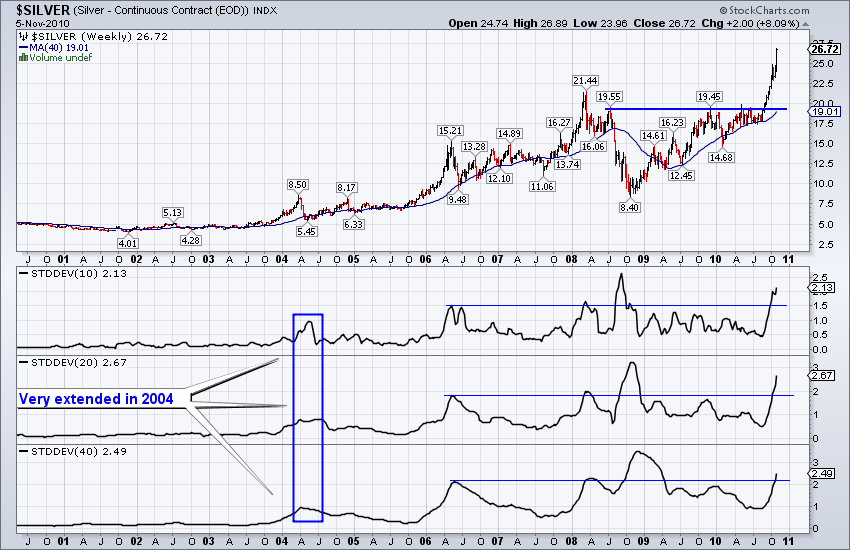
Silver has obviously had a very strong run. After breaking out past $19.50/oz, Silver has run all the way to nearly $27 with gains in eight of the past nine weeks. How much further can Silver run?

We see some confluence of targets at $32. Note that back in 1980 there was barely any trading in Silver from $25 to $33. In other words, when Silver crashed downwards, it fell quickly and then rallied back to $25. During the initial crash, it stabilized at $33. On the chart, one can see a very open space from $25 to $32.
Furthermore, $32 is roughly the 62% retracement of the major bear market from $50 down to $3. Also, if you take the difference between the resistance at $19.50 and the low at $8.40, you get nearly $31. The recent leg higher went from $18 to $25. A duplicate leg of $7 would take us to $31-$32 depending on where you start. There is quite the confluence of targets at $31-$32/oz.


In the chart below we show the standard deviations from the 10, 20 and 40 week moving averages.


The market looks quite stretched in each of those time frames. However, consider what happened in 2004. At the time, the standard deviations reached major new highs. With the market stretched right now it is important to know that there is more risk should you enter right now. At the same time, we also need to consider that the market can continue to rise before a larger correction begins. After all, it was only two months ago that Silver broke from an eight month consolidation. Odds are it will be at least a little while and probably longer, before another large consolidation or correction begins.

Good Luck!

Ingin Tahu Lebih Lanjut Mengenai Emas?

Dapatkan Quarterly Gold Investment Digest from World Gold Council

The Best Mobile Pre-Paid Plan


Add caption
FANDI
010-3242055